We walk along a busy street; cars whiz past us, making sounds like brushing a buzzing fly away from your ear. Buzz, buzz, buzz! We ignore them, generating our own excited chatter to cover up the noise of the city. Standing quietly inside churches for long periods of time can have that effect; voices hate to be silenced. The church is behind us. We release our poor, neglected voices into the buzzing Roman air. They complain, strained from their temporary imprisonment. A few girls huddle together and make weekend plans while walking; others giggle while sharing anecdotes.
Several students wonder aloud, asking each other where Shawn might be leading us today. A church, perhaps? Maybe a park? Questions fade as conversations weave through different topics. I ask Mindy if she wants to return to the Chiesa di San Francesco a Ripa with me after this activity, to better scrutinize the artwork in the church. She agrees. I smile and we continue walking.
A few students at the front of the group suddenly slow down; the rest of us match their pace to avoid a collision. I glance ahead in search of the source to the commotion. The only visible hints are glimpses of gold and red, which glint in the pounding sunlight. Eventually, our group comes to a complete stop. We spread out along the sidewalk. As the people blocking my view move to either side, I discover the purpose to our visit. The entire wall is lined with plaques of all sorts and sizes. Some look like cheap Chinese restaurant signs, with their attention-hungry red lettering against gold backgrounds. Others look like garden signs, with elegant, vibrantly colored flowers painted around the edges and black, handwritten calligraphy in the center. My eye scans the wall slowly. The plaques all blur together, but one stands out. It isn’t brightly colored or intricately designed. It is a simple marble rectangle, with Times New Roman lettering engraved perfectly into its surface.
In the back corner of my mind, I hear a voice. Everything else is muted. The blurry outline of a figure appears before my eyes. I am entranced; no one else seems to have noticed. Slowly, the silhouette comes into focus. It is a woman. Though young, she looks worn and ragged everywhere but her eyes; they shine through with such fierceness and intensity that I am taken aback. She stares directly at me and begins to speak.
“P. G. R.
F. G. GELA”
I was born Felicita Giudice, named for and destined to have a life of happiness. My parents, three brothers and I lived in Gela, an island town on Sicily. My father was an engraver; he usually carved gravestones. My mother stayed home to take care of us. Every day, my brothers and I would run to the shore and race one another to find the most perfectly preserved seashell, the most beautiful starfish, or even the shiniest pebble. At the end of the day, we would giggle together as we reconvened, comparing our discoveries and electing a winner. I usually won.
One day, as we were out collecting seashells, a heavy wind began blowing through Gela. Every islander knew the sign of a storm when they saw one. Luckily, I had not ventured far from town. As I ran home, a light rain began to fall. When I arrived, my parents hugged me tightly. We waited for my brothers to get home. The wind was getting stronger, the raindrops harder. Minutes later, my two oldest brothers found their way home. Relieved, I gave each one a huge hug. The five of us huddled together in the shelter, waiting for Francesco, our youngest brother. Time dragged by; minutes felt like hours as we stood together. Still, we waited. Finally, when none of us could bear it any longer, my father said he was going out to look for Francesco. We were all in tears; we knew that going out into the storm now meant slim survival chances. I almost begged him not to go, but then I thought of Francesco out alone, wandering in the violent storm. I looked up at my father, who reassured us that he would be back shortly. He nodded at me and left. That was the last time we ever saw him.
The next morning, we carefully ventured out into the devastation. My mother found Francesco huddled under the shelter of a fallen tree. Hugging him tightly, she carried my little brother home. Most of our neighbors were out searching for loved ones as well; we all helped each other. We searched for my father, but there was still no sign of him. While searching along the shore, I stopped to look out at the water, where he must have been taken. I could hardly believe how calm the sea was; her temper tantrum was over, and she slept. Falling on my knees in tears, I asked her how she could be so cruel, how she could tear my family apart, how she could take my kindhearted father, when there were so many others who so little deserved to live. She stared back coldly and selfishly; she was wordless and shameless. The Sea always gets what she wants.
We continued searching for a week, but it was futile. My mother could not stop sobbing and Francesco had fallen ill. He was feverish and delirious at times; at least it seemed so. We asked him questions, but he had not spoken a word since we found him. Meanwhile, my father’s engraving business fell into neglect. My oldest brother blamed himself; my father had always tried to teach him the trade, but my brother was never interested enough. He always came out to play with us instead of learning. Many were lost in the Sea’s fierce storm that day. Their relatives all came to our shop, begging us to engrave the tombstone for a loved one. Sadly, we turned them away. I had watched my father carve many stones, but I did not feel I could do justice to those who were lost in the storm.
We tried to nurse Francesco back to health, but his condition continued to deteriorate. The island hospitals were all busy with survivors of the storm; none of the hospital staff had the time or expertise to help Francesco. One kind nurse told us that my little brother’s voice suffered from trauma, and that we should seek help in Rome. We no longer had a reason to stay on the island, so we took her advice. We packed up all of our belongings, sold the shop to a visiting entrepreneur, and boarded a ship to mainland Italy.
We arrived on the shores and found our way to Rome. Francesco’s health was getting worse. One day, he fell into a deep sleep and we couldn’t wake him. Panicked, we rushed him to a Roman hospital. They told us he was in a coma and it was up to God to save him now. I felt like I would never stop crying, but our family had to be fed. My oldest brother and I went out searching for jobs; my brother apprenticed for a shoemaker, while I ended up working in a small jewelry shop.
Every Sunday, we attended mass at la Chiesa di San Francesco a Ripa. It was named after St. Francis, my brother Francesco’s patron saint. After every service, I stayed longer to pray for Francesco to get better. I prayed to the Virgin Mary, hoping she might understand the love for a young son. She had the power to plea for Francesco’s life on my family’s behalf. This I knew, and this I trusted in.
Every year, on Francesco’s birthday, we all went out and bought him gifts. We left them around his bedside, ready for when he awoke. Every night, I kneeled beside my little brother’s bed and prayed for him. Three years passed this way. My brothers began to despair; they worked more and visited less. Still, I continued to visit Francesco nightly to pray for him. I knew Mary would not abandon us, not with frail little Francesco still in need of so much help.
One Sunday, a month before Francesco’s eighth birthday, I finished praying for my little brother’s health and stood up from the church pew. I picked up my bag and headed toward the door. Halfway through the aisle, I was stopped by a voice.
“Felicita.” I turned. It was the resident priest. I could not remember a time when I had been in the church without him there.
“Yes, Father?”
“Do not despair. Your prayers will be answered.” He smiled discreetly and nodded before turning back around. A warm, comforting breeze washed through my mortal body, and I knew that he was right. Francesco would be okay.
Two weeks later, I went to visit Francesco as usual. I brought him flowers; his room needed more life. I gave him a light kiss on the forehead before turning around to set the vibrant bouquet on the windowsill. Just as the priest had beckoned me with my back turned, another voice called my name.
“Felicita?” The voice was raspy, though unmistakably young; years of disuse had left a scorched throat. Still, it was recognizeable.
“Francesco?” I wanted to wrap my arms around him in a gigantic, smothering hug, but years of tiptoeing around my frail brother warned me otherwise. Cautiously, I approached him. No, that voice couldn’t be real. My Francesco, awake? But he was! I knew I should run to find my other brothers and my mother, but I was selfish in my elation. I wanted a few more endless minutes with Francesco. He smiled weakly at me, and I smiled back. “Wait here,” I whispered guiltily, and dashed off to collect my family for the joyous reunion.
When Francesco was well again, we spent all of our evenings perfecting engraving together, in honor of our father. Proudly, Francesco announced that he would carry on the Giudice engraving business when he was older. My mother was so elated that she released a river of tears. That night, Francesco and I began carving our father’s tombstone, for when we returned to Gela.
A year later, we came across a beautiful, clean slab of marble. It was too clean, too perfect for any mortal. I told Francesco of a beautiful wall of prayer stones I had seen on my daily walk to la Chiesa di San Francesco a Ripa during the time that he had been sick. We still went to the church for Sunday mass; he told me he remembered the street altar. Right then, we knew what our next engraving would be.
We spent the next month working on the perfect gift to the Virgin. We wanted nothing more than to show her gratitude for answering our prayers. We wanted something simple — something that would show our thanks modestly, for she was never immodest. So we settled upon P. G. R. Per Grazia Ricevuta: For Your Consideration. And to sign our piece: F. G. Gela: a thank you from Felicita Giudice of Gela, but also for her beloved little brother, Francesco Giudice.
Felicita closes her brilliant eyes, draws her hood up, and begins to fade. Her blurry outline becomes a part of the wall; she vanishes into the city air. I am immobilized by her visit. My mind has too much to process; it cannot deal with mundane activities like movement. Around me, the chatter of my classmates grows louder, juxtaposed against the hum of the cars. The brightness of the Roman sun beats back into focus. Felicita is gone, but the plaque, the imprint of her life, remains on the wall. Here on this wall, hers is just one voice among many.
Friday, September 14, 2007

ILLUMINATION AND DARKNESS
GIFT FROM HEAVEN
Chiesa di Santa Maria in Cosmedin, Roma
Light illuminates the chapels, but halls between chapels remain banished in darkness. Windows line the top of the wall. The light pouring in through these openings renders the effect of Heaven shining its divine light down upon the earthly occupants of the church. Indeed, this idea of heaven and earth moving in proximity, in unison, is pervasive. The church floor contains a juxtaposed composition of the reminiscent squares and circles of heaven and earth, respectively. Below the heavenly windows, the walls are bare.
In one niche, darkness prevails; the tiny corner is untouched by daylight. Its turn will come: as the sun rotates, light will be cast upon even the smallest corner. The alcoves wait their turn patiently. For now, they receive only threadbare remnants of light, from moving beams which spotlight different sections of the marble floor.
In one corner, a single ray of light shines on a spot near a lone pillar. Seated in the center of the beam, a young lady looks up in bewilderment; her contact is loose. Deftly, she recovers and drips saline solution into her eye. It is as if planned. She looks up, and the healing light pours into her eye, moving evenly with the drip of the liquid solution. Unaware of the gift she has received, the lady stands up and moves away, out of the powerful light.
SIMPLICITY
Chiesa di San Giovenale, Orvieto
There is no artificial illumination in the church; it seems surreal. However, the blindingly bright day ensures plenty of natural light inside, streaming in through windows and open doorways. The church is simple- it lacks the ornate gilding or overwhelming fresco murals so prevalent elsewhere. The aisles are peaceful and empty. Here, the natural shadow and natural light are in constant competition.
A wide river of light bursts through a circular window overhead, pouring down into the church. As it descends, it bathes a beautiful stone pulpit in astonishing light. The effect is dramatic: the eye is immediately drawn to this marble object that might otherwise remain veiled in obscurity. The light alters the figure, sending a message: the simplistic is not without importance.
The focus of the church is not the faded walls, nor the unadorned ceiling of wooden rafters. There are no distractions to belief. In my mind, I see a priest at the pulpit, preaching to a solemn, devout crowd. He does not work for the attention of his audience. Here merely preaches what he knows, and the audience responds in kind. They already know to listen to him, for he is awash in the golden light.
Chiesa di Santa Maria in Cosmedin, Roma
Light illuminates the chapels, but halls between chapels remain banished in darkness. Windows line the top of the wall. The light pouring in through these openings renders the effect of Heaven shining its divine light down upon the earthly occupants of the church. Indeed, this idea of heaven and earth moving in proximity, in unison, is pervasive. The church floor contains a juxtaposed composition of the reminiscent squares and circles of heaven and earth, respectively. Below the heavenly windows, the walls are bare.
In one niche, darkness prevails; the tiny corner is untouched by daylight. Its turn will come: as the sun rotates, light will be cast upon even the smallest corner. The alcoves wait their turn patiently. For now, they receive only threadbare remnants of light, from moving beams which spotlight different sections of the marble floor.
In one corner, a single ray of light shines on a spot near a lone pillar. Seated in the center of the beam, a young lady looks up in bewilderment; her contact is loose. Deftly, she recovers and drips saline solution into her eye. It is as if planned. She looks up, and the healing light pours into her eye, moving evenly with the drip of the liquid solution. Unaware of the gift she has received, the lady stands up and moves away, out of the powerful light.
SIMPLICITY
Chiesa di San Giovenale, Orvieto
There is no artificial illumination in the church; it seems surreal. However, the blindingly bright day ensures plenty of natural light inside, streaming in through windows and open doorways. The church is simple- it lacks the ornate gilding or overwhelming fresco murals so prevalent elsewhere. The aisles are peaceful and empty. Here, the natural shadow and natural light are in constant competition.
A wide river of light bursts through a circular window overhead, pouring down into the church. As it descends, it bathes a beautiful stone pulpit in astonishing light. The effect is dramatic: the eye is immediately drawn to this marble object that might otherwise remain veiled in obscurity. The light alters the figure, sending a message: the simplistic is not without importance.
The focus of the church is not the faded walls, nor the unadorned ceiling of wooden rafters. There are no distractions to belief. In my mind, I see a priest at the pulpit, preaching to a solemn, devout crowd. He does not work for the attention of his audience. Here merely preaches what he knows, and the audience responds in kind. They already know to listen to him, for he is awash in the golden light.
Thursday, September 13, 2007
GRAFFIT'ITALIA

The electrocuted letters are frozen, shocked into eternal paralysis. The words have been sliced open, exposed. They are gigantic, throbbing veins: angry red blood cells burst forth from the confines of the black outlines. They attack with all the patience of a squirming child waiting in line for the restroom. The grey invaders may be minute in stature, but they are formidable as an opponent. Still, the crimson creatures are ravenous in their greed; only the flash of paralyzing lightning prevents the demise of the outnumbered invaders. Time lies stagnant. Now, the invaders will never succeed while the defenders will never return to peace. Victory takes no sides in this war.
Black shadows lurk silently just beneath the open gash. They wait patiently for the moment when the blood cells have finally defeated the intruders- the day the crimson turns grey from sheer exhaustion. Then, it will be their turn. They will bleed out from the depths, droplets of ink escaping into a pool of crystal water, enveloping and contaminating everything in sight. The weakened defenders stand no chance. Predator will become prey when the darkness of night sweeps.
Alas, the patience of the shadows is of no avail. They, too, are immobilized by the vigorous lightning. The flash reveals the true grey of the shadows, which shrink back from the touch of the light. The letters cry out in pain as the sharp lightning bolt cuts into them, searing their flesh and snatching their souls. The lightning smiles wickedly in triumph: it has conquered all! But no, one final competitor plays his hand. It is Time, the ultimate victor. Silently, he nods, and the world freezes. The triumphant lightning is stuck at climax, the moment of violent struggle and just barely unattainable victory. Time has won again.
I stare at this glorious masterpiece: a modern rendering of those crucial moments from mythology once captured so valiantly by the Baroque masters of still movement. It is the modern Bernini: the desperation of Apollo and the despair of Daphne at her moment of transformation are replaced by an explosion of blood cells and grey disease-carriers streaming through the pulsing body of a word, only it is fourfold. Four struggles represented in one composition, three single letters. NTS.
My Holy Grail has two parts: image and message. Now the question begs an answer: how do I find them? How can I capture Kelsea in one set of letters? What image could feel right to me? I see word after word, image after image splayed across the rusty buildings. They say “defaced”, I say “beautified”. This is Italy, with its rich history of art and innovation, often combined. We watch frescoes and sculptures through the ages, marveling at the new techniques, new media, and new styles. Perhaps graffiti is the masterpiece of today. Maybe our descendants will preserve the brilliant art of nighttime and counterculture, touring the ancient graffiti sites and mourning the masterpieces that were eventually painted over or torn down. It is such an integral part of Italy now; I call it graffit’italia. I have found graffiti heaven; now all I have to do is find graffitikelsea.
Stretching across the span of almost three bridges, I discover rows and rows of graffiti. Names and words: some clear, some contorted beyond recognition. Each one was a meticulous effort. Each artist of each piece had a set of letters or images in mind that were worth documenting. I wonder about the names. Were they a representation of the self? Maybe a loved or admired one? What about the words or acronyms? They could be initials or organizations, or perhaps that which I search for: the word that defines the artist, or the artist’s message. I wonder if anyone chooses letters simply for their aesthetic value, with no meaning attached. My personal graffiti will not be that way: it will be representative. It will mean Kelsea, but it will not say “Kelsea”. That I have decided: my arbitrary given name will not be the name I give myself when I finally discover and illustrate my graffiti. It will be a word: a concept, perhaps, or a trait, or maybe even a verb. But it will not be my name.
I wonder about my image. How would I visually represent the letters I choose? Will it be like NTS: lively, tense, and brilliant, like the eruption of blood cells unleashing their rage? Will my letters be twisted like the green octopus legs on the side of the abandoned shack we passed by? I think it’ll have to be at the very edge of madness: it must be readable, but not immediately so. I’ll make the viewer work for my message; it will only be for those who care enough to make the effort, but those who do will be rewarded. My image will be in motion; stagnancy is not my forte, nor my desire.
I love the lightning, captured in its very moment of triumph. I love the stars, transfixed at the height of their brilliance. I love the glimmer of the newest graffiti, the brightest colors and the deepest shading. My graffiti will stand out- it will be somewhat grandiose, but it won’t be a mad explosion of circus colors. It will have a sort of chaotic organization- it might even be a combined amalgam of styles and experimentations. It will have life, passion, energy, ferocity, and possibly even teeth. It will be bathed in reds, blues, and blacks. And so this is my folle vole: not to physically find my message in this graffiti paradise, this graffit’italia, but to garner inspiration from bits and pieces of other people’s personal graffiti and put them together to form my own: my graffitikelsea.
Sunday, September 9, 2007
THE DANCERS
The city roars with life. Tonight, Rome is a river, swarming with all sorts of creatures. Some belong to the city, while others traveled thousands of miles to reach this destination. The only similarity between the parts of this mass collection of people is their movement; they are a school of fish. They gather in this conclave of humans, not merely for another Roman night. No, tonight is the night: the Notte Bianca. Our clan of university students looks massive during the daytime; tonight, we are a tiny group of just eleven.
My world lacks scent; I lost my sense of smell on the Capitoline Hill, more accurately named the Anthill tonight. My nose gave away her precious function in disgust; the wind carried it away, the way it carried the odor of thousands of living, breathing, shouting Romans through the crowds. We escaped the lumbering giant climbing up to see the concert; we pushed downward, through the crowd, to escape. Finally, we are here: the Corso Vittorio Emmanuele II.
Joel leads, discovering a path around the mass. We follow as he darts through mazes of poles, across a tiny park square with token trees and dilapidated green benches, around the edge of the crowd. We are headed to the Colosseum, to see my beloved site in all its nighttime brilliance. We hear it’s spectacular.
Suddenly, Joel takes off running. Tonight, we are on the buddy system. As any reliable buddy will do, Schuyler takes off after Joel. As a generally responsible person might do, Henry takes off after both of them. Laughing, the rest of us maintain our somewhat-leisurely pace. We know we’ll catch up to them eventually, as always.
We do catch up. The three guys are standing on a hill, which is cut vertically and held up by a concrete retaining wall to line the Corso Vittorio Emmanuele II. Joel looks ecstatic; following his gaze, we understand. Below, a small band begins playing. Drums, drums, drums! The beat is alternately light and heavy. It is uplifting and lively. The rhythms are foreign to me; I am too meticulous for this music. It is dancing music, but I have no idea how to begin dancing to it. I would need time to absorb, to think, to familiarize, but this is spontaneous music. Joel has no such qualms; he dives in, dancing to the peculiar beat. Around him, people cheer. My other companions giggle helplessly; I join in the infectious laughter.
Joel dances for an entire song before any of us join him. Cashing in on a bet won earlier, Linda convinces Mitch to join Joel. Mitch tries his best to match Joel’s movement. Joel’s dancing is like an instrument added to the ensemble; he is at perfect pitch. He is impossible to imitate tonight, but Mitch is persistent.
Linda attempts to convince Scott to join the fray, but Scott is adamant. He already seems distressed by his companion participating in the dancing. Unfazed by Scott’s resistance, Linda joins the dancers instead. The three of them make an odd trio: one moves naturally with the beat, one is learning how, and the other does her own dance. I watch them and wish I had the courage to join them. For now, my place is on the sideline, taking a mental video of my three brave companions.
My Notte Bianca wasn’t the Capitoline concert, the glowing Colosseum, the ubiquitous crowd, or the blazing fire troupes. It was three dancers dancing to a beat I could not even begin to understand. Three dancers captured in a moment of enlightenment, taught by music of which I could only hear the surface.
My world lacks scent; I lost my sense of smell on the Capitoline Hill, more accurately named the Anthill tonight. My nose gave away her precious function in disgust; the wind carried it away, the way it carried the odor of thousands of living, breathing, shouting Romans through the crowds. We escaped the lumbering giant climbing up to see the concert; we pushed downward, through the crowd, to escape. Finally, we are here: the Corso Vittorio Emmanuele II.
Joel leads, discovering a path around the mass. We follow as he darts through mazes of poles, across a tiny park square with token trees and dilapidated green benches, around the edge of the crowd. We are headed to the Colosseum, to see my beloved site in all its nighttime brilliance. We hear it’s spectacular.
Suddenly, Joel takes off running. Tonight, we are on the buddy system. As any reliable buddy will do, Schuyler takes off after Joel. As a generally responsible person might do, Henry takes off after both of them. Laughing, the rest of us maintain our somewhat-leisurely pace. We know we’ll catch up to them eventually, as always.
We do catch up. The three guys are standing on a hill, which is cut vertically and held up by a concrete retaining wall to line the Corso Vittorio Emmanuele II. Joel looks ecstatic; following his gaze, we understand. Below, a small band begins playing. Drums, drums, drums! The beat is alternately light and heavy. It is uplifting and lively. The rhythms are foreign to me; I am too meticulous for this music. It is dancing music, but I have no idea how to begin dancing to it. I would need time to absorb, to think, to familiarize, but this is spontaneous music. Joel has no such qualms; he dives in, dancing to the peculiar beat. Around him, people cheer. My other companions giggle helplessly; I join in the infectious laughter.
Joel dances for an entire song before any of us join him. Cashing in on a bet won earlier, Linda convinces Mitch to join Joel. Mitch tries his best to match Joel’s movement. Joel’s dancing is like an instrument added to the ensemble; he is at perfect pitch. He is impossible to imitate tonight, but Mitch is persistent.
Linda attempts to convince Scott to join the fray, but Scott is adamant. He already seems distressed by his companion participating in the dancing. Unfazed by Scott’s resistance, Linda joins the dancers instead. The three of them make an odd trio: one moves naturally with the beat, one is learning how, and the other does her own dance. I watch them and wish I had the courage to join them. For now, my place is on the sideline, taking a mental video of my three brave companions.
My Notte Bianca wasn’t the Capitoline concert, the glowing Colosseum, the ubiquitous crowd, or the blazing fire troupes. It was three dancers dancing to a beat I could not even begin to understand. Three dancers captured in a moment of enlightenment, taught by music of which I could only hear the surface.
Saturday, September 8, 2007
APOLLO E DAFNE

The pristine leaves strike my eye, their forms so delicate,
so fragile behind the visage
of rough travertine and tamed purity.
Her face melts into a mask of despair, of undisguised agony,
pure agony,
her skin soft and smooth with round cheeks like a baby’s.
She is half beauty, half tree, and wholly consumed by desperation.
Even as she leaps forward, she is rooted,
her legs growing scales as the earth grows around her,
snatching her as one of its own
to live and play among the hummingbirds and beds of daisies.
He runs madly,
like the wind is chasing him,
only he is the one chasing the girl who is as elusive as the wind.
Slowly, I stroll around the pinnacle moment trapped in stone,
watching as the scene unfolds before my eyes,
marble figures unaware of their awed audience.
I pause between the two figures, indecision clawing at me
while both characters beg for my sympathy to reside with them,
but I cannot make the choice.
Dafne’s terror makes my heart pound faster
as I nervously twirl my hair into ringlets,
twisting the strands until they are stiff as rope.
My body reels from the shock
of the stabbing pain in Apollo’s heart,
as he watches his love transform.
I turn away at last,
unable to endure the pain of Dafne’s plight and Apollo’s sorrow.
I do not turn back,
until at last Dafne lies in peace,
while Apollo’s heart lies in pieces.
ENTRATA, USCITA
It is like watching someone else’s heaven through glass windows: a dream realized for the rich and lofty, but just out of grasp for us mere mortals. The very shoes sneer at us from their pedestals; we dare not sneak a glimpse of the coats for more than a fleeting moment. Prada, Gucci, Chanel, Miu Miu, Armani, and Louis Vuitton are all in competition. They remain when night falls and the lingering shoppers finally wander back to the comfort of their homes. They stay rooted, and they argue. Gucci boasts an astounding new fall collection; Armani makes a cutting retort about Gucci’s Autumn 2006. Prada is prouder; she refuses to join in the bickering, feigning sleep instead. Vuitton stifles a yawn, while Miu Miu sighs; she misses Paris, but she always does.
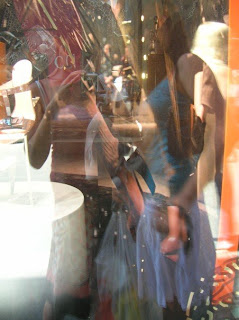 In the morning, they fall silent. The words are unnecessary, wasted on the wholly absorbed shoppers who have eyes only for colors and fabrics. We stroll by, under the piercing gaze of swarms of salespeople hovering near fancy glass doors. The Vogue or Elle type of beauty resides here: flaws find no victims on this street. The displays are immaculate; they hardly need the glass barrier, for even the curious would hate to disturb them. We approach Prada Italia, watching our reflection-twins as they take their own cautious steps toward us. We never quite meet them, but they are just inches away. My friend and I watch as my mirror image pulls out her camera to record our visit. Likewise, I document hers: focused stare juxtaposed against the pristine Prada display.
We wave goodbye to our pseudo-twins and carry on. The streets are wide and open; the wind dances between us and around us. Beams of sunlight chase her mischievously, as satyrs chase nymphs, but she merely giggles and dashes playfully out of the way. She learned from Tantalus himself. We smile at her elusive charm as we bask in the trail of light left behind by the pursuit of her ardent suitor. Here, the designer stores are allowed to breathe, to live. They interact as individuals in a collective society. It is no stuffy indoor mall, with lifeless mannequins and artificial lighting. No, it is open air, unsullied, liberated. We wave farewell to Prada, to Vuitton, to Chanel, as we pass by.
 We reach a piazza. It is colossal; the characteristic uneven Roman cobblestones surround us like a flowing tide. The stones nudge my toes gently through my faded black ballerina flats. The contours of my feet mesh with the shape of the Roman ground; I float with Rome; I become a part of Rome. In this unshackled space, we drift: around the fountain, with its crystal, aquamarine water and pristine, honeycomb ripples. The Spanish Steps loom ahead: a staircase to the unknown. We cannot see the top, the end. But then, what does it matter? If there ever existed a staircase without a true destination, it would be this one. It is not like the other staircases, which exist solely as a means of transportation. The Steps are the destination.

Our arduous journey up the staircase begins. We halt alternately to take pictures with the vast expanse of marble. The first tier ends, and we spill out onto the sides, for no direct path through the middle exists. Right side or left side? It doesn’t matter, for entrance and exit are immaterial in this staircase. We make a choice and carve our path through walls of lingering tourists. They pause on the steps to capture digital moments, sit on the stony steps, or nourish their parched throats with a few sips of refreshing water, the panacea of dehydrated travelers.
Our ascent continues, and the comforting sun grows harsher and crueler; he is nervous about our impending approach. Our reassurances are to no avail; he continues his cruel assault. My flesh sizzles and darkens at his touch, but I push through the torture and continue up the staircase. I wander across the marble, up the stairs, down the stairs, through the stairs. We never reach the top. We do not need to, for we are already here, where entrata and uscita are nothing more than Italian words.
The Spanish Steps are behind us. A short, leisurely walk leads us to the Chiesa di Santa Maria della Cancezione. The church boasts an alarming size; it is a mass of solemn bricks, which seize us with their collective, judgmental glare. They are fiercely protective of the souls they house within. Cautiously, I nod at them in reassurance before crossing the border into the silence.
The corridor for humans to tread upon is narrow and dimly lit, but we can hardly complain, for the twenty-one of us spread out through the simple hallway, while the ghosts of four thousand Capuchin monks crowd into the tiny chapels with a combined area of just over three times the size of the corridor for the living. They do not complain; they are austere, rigid in their vows and their lifestyles. Even in death, their bones are arranged meticulously. To the Capuchin, it is clear and simple: life and death are inevitable.
The narrow corridor with a single door is a reminder: there is no escape. The layout is simple. The hallway is one straight rectangle. We enter, we pass through, and then the end arrives. When it does, there is nothing to do, nowhere to run. The Capuchin monks didn’t build an escape at the other end. The only door out is the door in.
As we pass each chapel, bones envelop us in their chilling embrace. Femurs form an arch, housing the robed skeleton of a Capuchin monk. Above our heads, vertebrae lanterns cast their eerie glow upon us, the intruders. They predict the end; they are obsessed with the end. They know that the exit is no exit at all; it is another entrance into another life. Thus, they do not have exits. Entrata, Uscita. Here, they are one.
 In the morning, they fall silent. The words are unnecessary, wasted on the wholly absorbed shoppers who have eyes only for colors and fabrics. We stroll by, under the piercing gaze of swarms of salespeople hovering near fancy glass doors. The Vogue or Elle type of beauty resides here: flaws find no victims on this street. The displays are immaculate; they hardly need the glass barrier, for even the curious would hate to disturb them. We approach Prada Italia, watching our reflection-twins as they take their own cautious steps toward us. We never quite meet them, but they are just inches away. My friend and I watch as my mirror image pulls out her camera to record our visit. Likewise, I document hers: focused stare juxtaposed against the pristine Prada display.
We wave goodbye to our pseudo-twins and carry on. The streets are wide and open; the wind dances between us and around us. Beams of sunlight chase her mischievously, as satyrs chase nymphs, but she merely giggles and dashes playfully out of the way. She learned from Tantalus himself. We smile at her elusive charm as we bask in the trail of light left behind by the pursuit of her ardent suitor. Here, the designer stores are allowed to breathe, to live. They interact as individuals in a collective society. It is no stuffy indoor mall, with lifeless mannequins and artificial lighting. No, it is open air, unsullied, liberated. We wave farewell to Prada, to Vuitton, to Chanel, as we pass by.
 We reach a piazza. It is colossal; the characteristic uneven Roman cobblestones surround us like a flowing tide. The stones nudge my toes gently through my faded black ballerina flats. The contours of my feet mesh with the shape of the Roman ground; I float with Rome; I become a part of Rome. In this unshackled space, we drift: around the fountain, with its crystal, aquamarine water and pristine, honeycomb ripples. The Spanish Steps loom ahead: a staircase to the unknown. We cannot see the top, the end. But then, what does it matter? If there ever existed a staircase without a true destination, it would be this one. It is not like the other staircases, which exist solely as a means of transportation. The Steps are the destination.
Our arduous journey up the staircase begins. We halt alternately to take pictures with the vast expanse of marble. The first tier ends, and we spill out onto the sides, for no direct path through the middle exists. Right side or left side? It doesn’t matter, for entrance and exit are immaterial in this staircase. We make a choice and carve our path through walls of lingering tourists. They pause on the steps to capture digital moments, sit on the stony steps, or nourish their parched throats with a few sips of refreshing water, the panacea of dehydrated travelers.
Our ascent continues, and the comforting sun grows harsher and crueler; he is nervous about our impending approach. Our reassurances are to no avail; he continues his cruel assault. My flesh sizzles and darkens at his touch, but I push through the torture and continue up the staircase. I wander across the marble, up the stairs, down the stairs, through the stairs. We never reach the top. We do not need to, for we are already here, where entrata and uscita are nothing more than Italian words.
The Spanish Steps are behind us. A short, leisurely walk leads us to the Chiesa di Santa Maria della Cancezione. The church boasts an alarming size; it is a mass of solemn bricks, which seize us with their collective, judgmental glare. They are fiercely protective of the souls they house within. Cautiously, I nod at them in reassurance before crossing the border into the silence.
The corridor for humans to tread upon is narrow and dimly lit, but we can hardly complain, for the twenty-one of us spread out through the simple hallway, while the ghosts of four thousand Capuchin monks crowd into the tiny chapels with a combined area of just over three times the size of the corridor for the living. They do not complain; they are austere, rigid in their vows and their lifestyles. Even in death, their bones are arranged meticulously. To the Capuchin, it is clear and simple: life and death are inevitable.
The narrow corridor with a single door is a reminder: there is no escape. The layout is simple. The hallway is one straight rectangle. We enter, we pass through, and then the end arrives. When it does, there is nothing to do, nowhere to run. The Capuchin monks didn’t build an escape at the other end. The only door out is the door in.
As we pass each chapel, bones envelop us in their chilling embrace. Femurs form an arch, housing the robed skeleton of a Capuchin monk. Above our heads, vertebrae lanterns cast their eerie glow upon us, the intruders. They predict the end; they are obsessed with the end. They know that the exit is no exit at all; it is another entrance into another life. Thus, they do not have exits. Entrata, Uscita. Here, they are one.
Friday, September 7, 2007
The Elusive Scent of Orvieto
What is a life without smell? This sickness has stolen all scents from me. I mourn, for I cannot smell Orvieto. I can taste the crispness of the light summer air. I can feel the warmth of the sun’s embrace. But I cannot smell the air. I can only imagine.
Subscribe to:
Posts (Atom)